
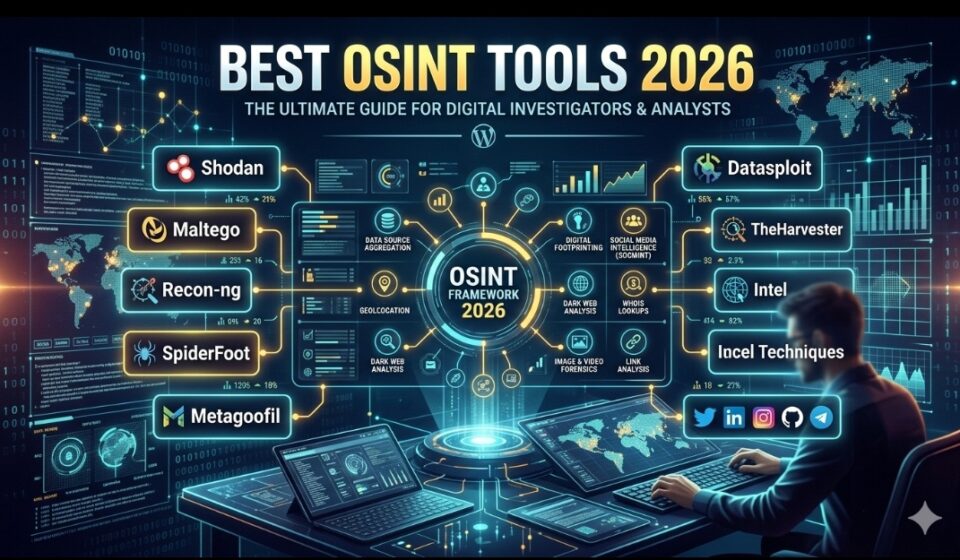
Best OSINT Tools 2026: The Complete Guide for Security Professionals
Top OSINT Tools 2026 + Open Source Intelligence 2023 & Cyber Threat AnalysisRe– Maltego, Shodan, SpiderFoot, theHarvester and Recon-ng are the best open-source intelligence-gathering tools of cyber threat analysis. Regardless if you are a penetration tester, SOC analyst, or digital investigator these tools provide us the ability to quickly and legally surface actionable intelligence from open data.
In this guide, we provide the core strengths of each tool, use templates for when to leverage them, and show how all this fits into a modern OSINT workflow.
What is OSINT and Why Use It in 2026?
Open-Source Intelligence (OSINT) is the collection and analysis of publicly available information where the data can come from websites, social media, DNS records, breach databases and even very secretive dark web locations.
And there are higher stakes than ever in 2026. Threat actors have started operationalizing OSINT for themselves, researching their targets, finding exposed assets and gathering leaked credentials at the launch of an attack. If security teams are not proactively using OSINT, they are almost operating blind.
This urgency is echoed in the global OSINT market. With a valuation of US$5.02 billion in 2018, this market is expected to reach a value of $29.19 billion by 2026 — representing a compound annual growth rate (CAGR) of 24.7% over the forecast period.
Selection Of Correct OSINT Tool
Not all OSINT tools fit in all workflows. Keep these key criteria in mind before choosing a platform
scope: is it one of social media, infrastructure or breach data or all three;
Automation — Does it support running on-demand, headless scans automatically?
Integration: Does it integrate with your SIEMs, SOAR platforms or any other tooling?
Difficulty: CLI-heavy tools (ex. Recon-ng) require more technical acumen;
Cost: While Free open-source tools can be very powerful, enterprise programs typically require paid tiers to automate dev workflow or scale.
Best OSINT Tools — October 2026
1. Maltego — Best for Visual Link Analysis and Investigations
License type: Commercial (free Community Edition; Pro from ~1,000$/year)
Ideal for: Cybercrime investigations, threat actor profiling, due diligence in corporate environment

Regarded as the gold standard in visual OSINT investigation, Maltego Using a graph-based interface built especially for creating relations between entities — domains, IP addresses, email accounts, social profiles, and organizations — it runs automated queries known as Transforms against hundreds of external data sources.
Maltego exposes links that linear tools will completely overlook and is the one common tool of choice for law enforcement agencies, intelligence analysts, and enterprise red teams.
Key Features:
- Graph-based relationship visualization
- 300+ Pre-Built Transform Integrations (Shodan, VirusTotal, HaveIBeenPwned & more)
- Machines offer automated multi-step investigation workflows
- Which to Export for Reporting: CSV, XLSX and Graph
Community Edition free for researchers
Best for: You’re researching a phishing operation and want to follow domain, hosting IPs, registrar patterns, and associate threat actor handles on a single visual surface.
Honest Shortcoming: Maltego comes with a steep learning curve. For automating bulk scans, analysts who favor an automated approach may see faster results initially with SpiderFoot.
2. Shodan — The Best Internet Asset and IoT Recon Tool
Pricing: Freemium (Free Tier Available; Paid API Plans from $59/month)
Best suited for: Network reconnaissance, IoT security, exposed asset discovery
Shodan: Sometimes called the “Google for hackers,” Shodan is a search engine that continuously scans and indexes devices connected to the internet — servers, routers, webcams, Internet of Things devices, industrial control systems and more. It is not just a query system like search engines, it returns technical metadata: open ports, running services, software versions and some vulnerabilities.
Shodan is also vital for penetration testers and attack surface managers during pre-engagement reconnaissance. It knows if a target’s infrastructure is running old software, exposed services even before sending a single packet.
Key Features:
- Billions of Internet-connected devices (indexed in real-time)
- allows searching by IP, port, protocol, banner/hostname/geo
- CVE and vulnerability correlation
- Automated and pipeline integration by API access `
Monitoring mode — alert on each new exposure
Best Use Case: An internal security team is looking to audit its own external attack surface — finding things like exposed RDP instances, misconfigured S3 buckets flagged via linked meta data, or unpatched services before attackers do.
Honest Limitation: Shodan is specialized. While it’s great for infrastructure reconnaissance, it doesn’t do social media, breach data or identity pivoting at the level that full-platform tools do.
3. SpiderFoot — The Best Automated, Comprehensive Recon Tool
Model: Open-source (free) + SpiderFoot HX commercial version
Suitable for: Automated Attack Surface Scanning, SOC monitoring, Mass Reconnaissance

SpiderFoot is OSINT automation engine, ideal for analysts who require breadth over depth. The tool executes a single query on domain, IP address, email or username removing the need to do manual searches across 200+ external data sources — includying WHOIS, DNS, breach databases, dark web indices and social platforms – before returning structuredcard correlated results in its integrated web interface.
Security professionals often execute SpiderFoot in head-less mode (that is, without a graphical user interface) as a scheduled task to populate dashboards or alerting tooling on potential new attack surface exposure.
Key Features:
- (- 200+ integrated modules data source
- Support for Web based UI & CLI
- Headless/API for automation pipelines
- Self-hosted (open-source) or cloud-hosted (HX) ✅
- Removing Structured output for SIEM and dashboard ingestion
Best use case: SOC team with need for continuous monitoring of their organizations external footprint — running nightly SpiderFoot scans sending alerts to their siem whenever new subdomains, leaked credentials or anything exposed is detected.
Honest Limitation: Automation means volume. SpiderFoot scans return large result sets that need to be triaged by analysts. If you are conducting a focused, hypothesis-driven investigation, Maltego in manual pivot mode generated more targeted output.
4. theHarvester – The Best Light Weight Tool for Email and Subdomain Enumeration
License: Open-source (free, comes pre-installed in Kali Linux)
Best for: pre-engagement reconnaissance, quick first-pass checks, PenTesting
theHarvester is the goto tool of penetration testers for executing quick & dirty passive reconnaissance. By querying public search engines (Google, Bing, DuckDuckGo), PGP key servers, LinkedIn and other 🔓 open data sources it collects email addresses, subdomains, hostnames and IPs.
Its simplicity is its strength. No complicated setup, no bouncing off an API key, no learning curve; it is something you can bring to your front door for the first time before enrichment with SpiderFoot or Maltego.
Key Features:
- Collects emails, subdomains, IPs and employee names
- Multi-searched (Google, Bing, Baidu, LinkedIn etc.)
- — XML, JSON and HTML output for downstream processing
- Fast and small; easily scripts in Bash and Python
- (bundled by default in Kali Linux and Parrot OS )
Best Use Case: The penetration tester initiates the engagement with theHarvester against a domain to quickly obtain email pattern, subdomains and IP ranges that can be scanned as part of deep testing.
Honesty Limitation; theHarvester is point tool, NOT a platform It does not have any advanced automation, graphical analysis, or correlation across data types. Its best used as the initial stage of a larger OSINT pipeline.
5. Recon-ng Recon-ng is an open-source web reconnaissance tool written in Python.
Type: Open-source (free)
Bset for: Red teamers, advanced analysts, pipeline-able automated workflows
Recon-ng is the Metasploit of OSINT- modular, RAPID, command-line reconnaissance framework that allows analysts to compose custom intelligence workflows by chaining individual modules together. It has a permanent workspace that saves results across runs, and each module focuses on one type of intelligence source or technique.
For teams whose use cases require repeatable version-controlled reconnaissance pipelines — automating CI/CD or an automated red team — Recon-ng offers a level of composability thatpre-packaged tools will not.
Key Features:
- Modular architecture (similar to Metasploit interface)
- Windows with persistence for investigation spanning multiple sessions
- Module level configuration for API integrations
- Database and reporting functionality out-of-the-box
- Scriptable and automation-friendly
Application — best use case: A red team constructs a repeatable reconnaissance playbook with Recon-ng modules — chaining together DNS enumeration and contact harvesting with credential leak lookups as a single automated workflow that is executed on every new client engagement.
Limitation: The CLI-only interface is a barrier for analysts who are not comfortable at the command line Would you use this? Recon-ng is a pretty niche tool — SpiderFoot’s UI may be more useful in practice by general security ops teams.
6. Finalist: Recorded Future Best Enterprise Threat Intelligence Platform
Type: Commercial (enterprise pricing)
Suitable for: Enterprise SOC teams, threat intelligence programs, real-time alerting
Recorded Future is an OSINT aggregation platform fuelled by AI — capturing dark web forums, technical threat actor communities, paste sites and breach databases in real time. The machine learning models analyze how signals are correlated across sources to generate risk scores predicting the likelihood of abusive activity and threat intelligence that can be acted upon.
In December 2024, Recorded Future was acquired by Mastercard More focused ahead and with some planned follow-up use cases beyond cybersecurity which have now been given its financial fraud intelligence too.
Key Features:
- — Monitoring of the dark web and technical community in real time
- Threat scoring with entity correlation based on AI
- – SIEM and SOAR native integrations (Splunk, Microsoft Sentinel and so on)
- Vulnerability prioritization based on CVE and adversary engagements
- Third-party risk intelligence and brand monitoring
Use Case: A CISO of an enterprise organization uses Recorded Future to continuously monitor for mentions of their infrastructure, leaked credentials, and emerging ransomware campaigns and takes action by only receiving enriched, contextualized alerts as opposed to raw data.
That said, the cost of Recorded Future makes it a distinct enterprise play. For organizations that do not have the resources to run a dedicated threat intelligence function, open-source alternatives often offer enough coverage for this type of solutions.
7. OWASP — Open Source Intelligence FrameworkSuggestions on discovering tools in the global landscape?
Type: Free, web-based
Ideal For: Researchers, Journalists and New Analysts Studying OSINT Tool Types
OSINT Framework is not an automated tool – but a curated intelligence resource map on the web, distributing hundreds of OSINT tools, databases and techniques based on investigation type. Include usernames, email address, domain, IP address, social media platforms and geolocation.
It is the top resource to save when you need to know what tool should be used for a new kind of investigation — and it costs nothing.
Key Features:
- Hundreds of OSINT resources sorted by category
- Sorted based on type of inquiry (usernames, emails, domains, dark web, etc)
- Signs of tools that may need to be registered or installed locally
- Can be used for research, educational purposes and investigation planning
- Continuously updated by the security community
Ideal Scenario: An analyst is querying an unknown username; they navigate to OSINT Framework and quickly identify some of the relevant platform-specific lookup tools and social network search resources.
Quick Reference for Comparison of OSINT Tools
| Word | Type | What it does | Price |
|—|—|—|—|
| Maltego | Visual investigation platform | Relationship mapping, cybercrime investigations | Free version; Pro from ~1K/yr |
| Shodan | Device search engine | IoT/infrastructure recon, asset exposure | Free tier; API from $59/mo |
| Tool | Type | Scope | Cost | |————————-|———–|——————-|———-| | SpiderFoot | Automated OSINT scanner | Broad automated recon, SOC monitoring | Free (native); HX paid |
CLI tool, very lightweight, email/subdomain enum and pentest recon | Free | theHarvester |
| Recon-ng | Modular CLI framework (advanced repeatable workflows, red teaming) | Free |
|Recorded Future| Enterprise TI platform | SOC/CISO-level threat intelligence |Enterprise pricing (FREE trial)|
| OSINT Framework | Reference Resource Map | Tool Discovery, Education & Investigation Planning | Free |
Building OSINT Pipelines the Professional Way (2026 Edition)
The best analysts do not use a one-hat-fits-all tool — instead reinforcing layered pipelines blending free and sales tools.
A usable flow would be like this:
First pass sweep — Use theHarvester or Recon-ng to quickly enumerate domains, emails and subdomains.
Infrastructure recon — Using Shodan to enumerate services exposed, ports opened and devices vulnerable
Automated wide area scan — Launch SpiderFoot against the complete target profile to discover breach exposure, DNS history and social fingerprints.
Maltego can be used to visualize your results — You may import your findings into Maltego and use it to model relationships between entities and identify places where further analysis could lead to actionable intelligence.
Have SpiderFoot or Recorded Future alerts fed into a SIEM for continuous 24/7 eyes on the attack surface.
Actually, APIs are where the real action is. The top OSINT practitioners lean heavily in automating data flow between tools rather than juggling UIs.
AI and OSINT in 2026: So What Changed
AI have led OSINT to the two different sides which makes Choosing the best OSINT tools 2026 more important than ever.
AI Is an OSINT accelerator: Recorded Future, NexVision, and the commercial tiers of Maltego all use some form of machine learning/NLP to remove false positives, correlate signals across a hundred sources and surface contextually relevant intelligence faster than any human analyst could ever do manually.
Attribution challenges due to deepfakes, AI-generated text and synthesized digital identities as a challenge for OSINT are already growing. Checking if a social media profile or document is legitimate should now involve additional levels of validation because older OSINT methods did not have to account for this need.
AI-aware OSINT tradecraft is now a core competency, not an esoteric specialty; and staying current is just that – you need to know how many pounds in a dollar.
Legal and Ethical Considerations
OSINT tools collect data that is in the public domain — but “publicly available” does not mean “free use.”
Important legal and ethical concepts that each member must adhere to:
European law on protection of personal data or GDPR applies in the event possible processing of personal identifiable information regardless from what source the data has been collected.
Scoping authorization:In penetration testing scenarios always have written authorization before doing any recon for a target organization official infrastructure.
Data minimisation: Collect only what you need to fulfil your intelligence requirement that you have defined.
Responsible disclosure: If an OSINT discovery points to something vulnerable in the infrastructure of a third party, apply responsible disclosure and avoid exploiting or disclosing your findings.
This discipline is so powerful because OSINT is legal, scalable, and non-intrusive from its nature — that status must be preserved with disciplined ethical practice.
– The Conclusion: Which OSINT Tool to Choose?
Individual researchers and students: Start with theHarvester, Recon-ng, OSINT Framework. They are free, well documented and encompass the basic reconnaissance skills.
Penetration testers: Mix theHarvester which does surface attacks with SpiderFoot for deeper scanning automatically.
SpiderFoot in automated mode is used by SOC analysts to monitor external exposure for separate assets with little overhead and it can feed a SIEM.
Digital Investigators and Forensics Teams: When complex investigations involving the mapping of relationships across multiple entities is vital, nothing beats graph visualization like Maltego.
Enterprise security programs – Recorded Future or Bitsight provides operationalized, AI-enriched threat intelligence at scale.
The one your operational context is the best suited for — not the feature-sets. So a consistently used properly tuned instance of SpiderFoot will win out over an expensive enterprise platform that is literally never integrated into the workflow as it was purchased.
All of the tools are for legal/authorized intelligence gathering only. Always check if your OSINT activities are in compliance with relevant laws and organizational policies before you conduct research.